Sampling hints & tips
Introduction
The purpose of asbestos sampling is to obtain representative bulk samples of suspected asbestos-containing materials for submission to a UKAS accredited laboratory for identification. Upon receipt, the laboratory will analyse the samples, usually by Polarised Light Microscopy (PLM), to determine whether or not asbestos is in fact present and, if it is, to determine the type(s) of asbestos the sample contains.
As a general rule, laboratories do not determine the percentage content of asbestos contaminants, as PLM is a qualitative rather than quantitative analytical technique. In addition, asbestos content tends to be somewhat irrelevant since, in the vast majority of situations, the only factor of any importance is whether or not asbestos is present.
It is vital that good sampling technique is employed during the collection of samples. This is to ensure that the person collecting the sample does not put themselves at risk of exposure to airborne asbestos fibres, nor should any other party be put at risk as a consequence of the sample being, or having been, collected.
This hints and tips page is intended to provide a set of practical measures, to persons intending to collect samples that may be adopted to ensure that sampling is carried out with minimal risk. Always follow a ‘common sense’ approach when sampling. Remember that the ‘risk’ is associated with asbestos fibres becoming airborne. Employ sensible measures to limit the chances of this occurring.
ATP accept no liability for any injury, or loss, incurred by any party carrying out sampling prior to, or subsequent to reading these notes. The notes do not represent any form of approved training course, formal or otherwise.
General
1. Use a disposable mask (P2 type minimum – P3 preferably) particularly if the material is friable (Lagging, textured coating (e.g. Artex), insulating board etc.)
2. Use disposable overalls, particularly if the material is friable (Lagging, textured coating (e.g. Artex), insulating board etc.)
3. Use an aerosol spray to dampen the sampling area before sampling
4. Depending on the likelihood of dust/debris generation, it may be prudent to place polythene on the floor beneath the sampling location before sampling. This is not normally necessary when sampling cement, vinyl or rope products.
5. Hold the sample bag (or other container) up to the sampling location and use an appropriate tool to collect the sample.
6. Take only a small sample (e.g. 10p – 50p size for cement/board or teaspoonful for textured coatings, such as Artex, or for insulation products).
7. Sample the full depth of product. (Some board products, for example, are asbestos-coated on only one side).
8. Place the sample bag inside a second bag after venting excess air from the bag (folding bag several times will usually achieve this)
9. Seal sampling site with spray glue (e.g. 3M Spraymount), PVA or paint. In some instances (e.g. where a core sample has been collected from pipe insulation) the application of strong adhesive tape, or Polyfilla, is useful for additional protection.
10. Ensure that sample containers are labelled.
11. Avoid cross contamination – use a wet wipe to clean sampling tools between each sample collection.
12. Place waste wet wipe in a separate bag (double bagged and labeled as waste) and send with the sample(s) to the laboratory for proper disposal.
13. Clean up any dust spillage (avoid in first place) using wet wipes.
Sampling
When sampling, it is always a good idea to determine whether there is an area of existing damage on the ‘suspect’ material that can be accessed and sampled, so as to minimise the level of disturbance. Debris from areas adjacent to the ‘suspect’ material should be submitted as a representative sample only if you can be 100% sure that it originated from the specific ‘suspect’ source.
Cement
For corrugated or flat sheet, use pliers to snip off a small corner of the cement product after first wetting the area. “Tip”: Alternatively, collect a small piece of existing debris if it clearly originates from the main body of material that is of concern. “Tip”: If the pliers still have serrated jaws, you can place a wet wipe over the area you are going to break off before starting. This will significantly reduce the chances of Asbestos debris becoming ingrained in the serrations. “Tip”: For cement products such as rainwater downpipes, where breaking off a small piece in a controlled manner is more difficult, use a sharp edged tool (e.g. chisel) to take a good surface scraping of the material
Insulating Board
Use the same methodologies as for asbestos cement butt make absolutely sure that the sampling area is thoroughly dampened before sampling.
This material contains a greater concentration of asbestos fibres than cement and is also considerably more friable. Always wear a mask and, where possible, disposable overalls.
Textured coating (e.g. Artex)
|
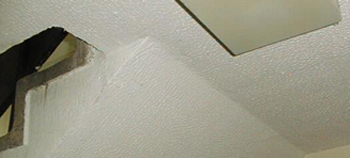
Hold an open sample bag up to the textured coating and use a sharp wood chisel to scrape an amount of the coating directly into the bag. It is important to repeat this process in a number of locations as the asbestos content is often not uniformly dispersed through the material. “Tip”: A small ‘matchpot’ of paint can be used to touch-up and seal the sample points. |
Rope/Webbing
|
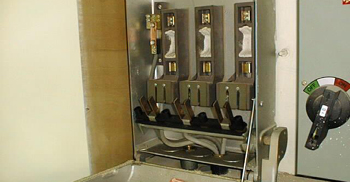
Always ensure that electrical, or other, plant has been made safe before attempting to collect samples. Remove a single ‘flashguard’ and place directly into the sample bag. This can be done by hand (gloved) if it is certain that the plant is safe, otherwise use a pair of insulated pliers. |
|
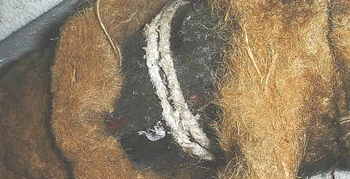
Asbestos rope may be found in a number of locations, from pipe work to fuse box door seals and oven doors. Wet the material thoroughly and use a sharp blade to cut off a centimetre or so. Place directly into a sample bag. |
Vinyl

|
When collecting samples of vinyl flooring material, use a sharp edged tool (e.g. Stanley knife or wood chisel) to cut off a section, ideally about the size of a 50p piece. “Tip” : It is important that the sample includes a reasonable amount of adhesive residue on the reverse side. This is because asbestos may be present in the vinyl, the adhesive or both. If no, or only a small amount, of adhesive is present, ensure that an additional quantity is collected and added to the sample. |
Insulation
|
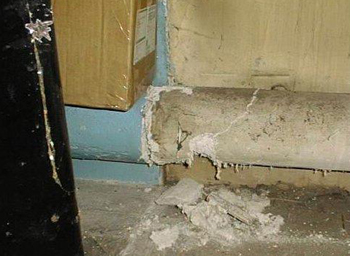
Best left to the experts because the potential for airborne fibre release is significant. If you must sample this type of material, use P3 mask, disposable overalls and gloves. Use an appropriate coring tool and wet the sampling area thoroughly. Place a polythene sheet beneath the sampling point to collect any debris and wet down the polythene before folding carefully and placing in a waste bag after sampling. Carefully seal the sample point with tape or filler on completion. “Tip” : Collect an existing sample of insulation debris, after dampening down the material and using gloved hands and mask, if it clearly originates from the main body of ‘suspect’ material. Do not try to clean up areas of debris, particularly using dustpan and brush or traditional vacuum cleaners, prior to confirmation of analysis results. You can however apply a liberal mist spray of water, or water/PVA mix, to reduce the possibility of airborne fibre generation. Also keep people away from debris fields until results of analysis are known. |